RDMxbCFS (Neuronenas) — Part 1
Within-participant DDM: random-dot motion vs masked-face decisions
The one-line thesis
Goal of Part 1: stand up and validate our in-house DDM data pipeline by measuring, within the same participant, whether perceptual decisions about random-dot motion and about masked RaFD faces are governed by comparable drift-diffusion signatures.
Two very different-looking 2AFC tasks — one classically "low-level" (motion), one "high-level" (faces) — run through the same pipeline, the same participant, the same parameters (v, a, t₀, z). If the drift-diffusion signatures line up, the pipeline is validated as a reusable, domain-general tool.
The argument in five acts
A map of the whole deck — from the design, through stimuli and the model, to the evidence and the power decision.
Design
- One-line thesis
- Two binocular 2AFC arms
- Versions V1 / V2 / V3
Stimuli & obscuring
- RaFD faces
- Graded Mondrian mask
- Matched difficulty ladder
DDM & four tests
- DDM primer
- Flagship design figure
- Tests T1–T4
Evidence & novelty
- 19-paper corpus
- Zero-precedent tally
- Retrieved effect sizes
Power & decisions
- Four claim tiers
- Decisions D1–D5 on the table
- Simulated power & N
The decision for the room lands in Act V: the five explicit choices D1–D5 — design version (§3), obscuring mechanism (§4), power anchor, claim tier and equivalence margin (§6) — each argued with its cost, and backed by the simulated power distributions. Everything before it is the evidence for that call.
Reproduction vs. novel — stated plainly
The face arm is not a strict reproduction. Across the 19-paper face-2AFC-DDM corpus, no study combines our elements (RaFD + graded masking + strict 2AFC + full v/a/t₀/z fit) on either axis.
What is established
- The RDM arm — Palmer, Huk & Shadlen 2005, well-established proportional-rate diffusion model
- The direction of the face effect — masking lowers drift (Williams et al. 2023)
What is new
- The combination: RaFD + graded masking + strict 2AFC + full
v/a/t₀/zfit — 0/19 precedent for this exact bundle, on either axis
Part 1 therefore reproduces established directions and methods while being, in combination, a novel design — which is precisely where the publishable contribution sits.
Two binocular 2AFC arms, within participant
Presentation is binocular (both eyes, no dichoptic rivalry) — Part 1 is deliberately the pre-CFS validation baseline.
Arm A — RDM
- Binary choice
- left vs right motion
- Difficulty ladder
- ~5 coherence levels {3.2, 6.4, 12.8, 25.6, 51.2}%
- DDM prediction
- drift v ↑ with coherence (µ′ = k·x, k ~ N(21,6))
- Anchor
- Palmer, Huk & Shadlen 2005
Arm B — Faces (RaFD)
- Binary choice
- see design versions V1/V2/V3
- Difficulty ladder
- ~5 graded binocular flashing-Mondrian mask levels
- DDM prediction
- drift v ↓ with obscuring (Δv ≈ −0.38 … −1.12)
- Anchor
- Williams et al. 2023 (RaFD, DDM)
Both arms yield choice + RT on every trial → DDM. Dependent measures are identical: v, a, t₀, z.
Random-dot motion — the coherence ladder
Stimulus & task
- Coherence ladder: {3.2, 6.4, 12.8, 25.6, 51.2}%
- Left vs right motion, forced 2AFC
- Built on the PI's own open PsychoPy RDK (
abcsds/RDM, 2024)
Drift model
µ′ = k·x
Drift scales linearly with coherence proportion x; sensitivity modeled as k ~ N(21,6) between subjects (range ≈ 9–28) across observers/experiments (Palmer, Huk & Shadlen 2005, Table 2).
Anchor: Palmer, Huk & Shadlen (2005) — normalized bound A′ ≈ 0.71, non-decision time tR ≈ 300–420 ms, threshold ratio ≈ 3.0–3.8, validating the proportional-rate model across 5 experiments.
Masked faces — graded binocular Mondrian obscuring
The manipulation
- ~5 graded binocular flashing-Mondrian mask levels, titrating discriminability — mirrors coherence in Arm A
- Mask levels degrade the RaFD face image progressively, not a single fixed occlusion
Why "pre-CFS"
Despite "CFS" in the project name, Part 1 is deliberately the pre-CFS validation baseline: the flashing Mondrians are a graded masking/degradation of a binocularly-viewed face, not interocular suppression.
No rivalry, both eyes = pre-CFS baseline.
Anchor: Williams et al. 2023 (Sci. Reports) — face-mask occlusion lowers drift rate v; two independent pre-registered studies (N=228 RaFD, N=264 RADIATE).
One trial, both arms — the timeline
Fixation → stimulus (coherence / mask) → response. Identical structure across arms; every trial yields choice + RT.
Three design versions — flagship = V2 + V1 pilot
| Version | Face binary choice | Literature anchor | Notes |
|---|---|---|---|
| V1 — Gaze | left vs right gaze direction | none no published gaze-discrimination drift estimate | Elegant structural parallel to RDM motion-direction. Highest novelty; pilot-dependent. |
| V2 — Emotion | angry vs happy | Williams 2023 masking→v on RaFD | Best-anchored; recommended flagship. |
| V3 — Factorial | gaze × emotion (2×2) | partial emotion anchored, gaze not | Richest, most publishable single study; largest N. PI leans here. |
Flagship recommendation: run V2 (emotion) as the flagship and a ~10-person V1 (gaze) pilot in parallel to obtain the missing gaze drift anchor; keep V3 costed and ready as the ambitious variant.
RaFD, not FACES
RaFD (chosen)
- Radboud Faces Database — 8040 images on disk
- 67 IDs (adults + children) × 8 expressions (anger, disgust, fear, happiness, sadness, surprise, contempt, neutral)
- × 5 camera angles × 3 gaze directions (left / frontal / right)
- Frontal camera angle used for this study
- Free for academic use (Langner et al. 2010)
FACES (Ebner 2010) — not chosen
- 171 models across 3 age groups
- 6 expressions (neutrality, sadness, disgust, fear, anger, happiness)
- Frontal shots only — no gaze-direction variation
- Would rule out V1 (gaze) and V3 (factorial) entirely
RaFD is not novel to this corpus — our anchor paper (Williams 2023, Study 1) uses it. The choice is justified on RaFD's own validation (Langner et al. 2010) and its 3 gaze directions (needed for V1/V3), not as a zero-precedent novelty, with low-level confounds (luminance, contrast, spatial frequency) controlled per Purcell 1996, Becker 2011, Calvo 2016.
Real RaFD stimuli — the two manipulated dimensions


Radboud Faces Database (RaFD), Langner et al. 2010 — academic use, kept local. Frontal camera (Rafd090), model 01.
Columns = gaze (V1), rows = emotion (V2), the 2×2 = the factorial (V3). Only gaze and expression vary. A separate in-house synthetic set is used only for pipeline tests.
The obscuring mechanism — graded Mondrian masking
Only 1 distinct corpus study masks at all (Williams 2023; Hartmann 2021 is its preprint, not an independent second study), and it is binary (masked vs. unmasked). A continuously graded mask — mirroring the coherence ladder in Arm A — has zero precedent in the face-DDM literature.
Justified from
- Newsome & Paré 1988 — coherence/noise-dot fraction logic
- Tsuchiya & Koch 2005 — 10 Hz Mondrian dynamics
Not justified from
- Any face-DDM precedent — none exists
- The RDM/CFS graded-noise tradition is the source, not the face literature
Mask levels titrate discriminability, mirroring coherence in Arm A — imported wholesale from the RDM/CFS tradition rather than replicated from a face-DDM template.
Matched graded difficulty — coherence ↔ mask
The four scientific tests, T1–T4
T1
Graded within-subject drop in v across obscuring — does obscuring lower drift?
T2
Parameter selectivity — is the effect drift-specific (v moves, a/t₀ don't)?
T3 ★
Cross-arm equivalence (TOST) — is the coherence→v slope quantitatively equivalent to the obscuring→v slope, in the same person?
T4
Individual-differences convergent validity — do motion-drift and face-drift covary across people?
T3 is the claim that certifies the pipeline as a reusable tool — quantitative equivalence between a "low-level" and a "high-level" decision would mean the DDM is reading out a domain-general accumulation process.
DDM 60-second primer
Why choice + RT, not mean RT: a single mean-RT number collapses four dissociable processes into one. Tipples (2023): an emotion-DDM conclusion can flip with outlier-removal / RT-model choices — never trust mean RT alone.
Flagship — the entire design at a glance
EZ (screen) + HDDM (confirm)
EZ-diffusion
Wagenmakers 2007 — fast, closed-form per-subject baseline. 0/19 precedent — chosen from best-practices, not the corpus.
HDDM
Wiecki, Sofer & Frank 2013 — hierarchical Bayesian. Plurality choice among corpus papers naming a method (4/6).
Why HDDM is required
Simulated parameter recovery at our trial budget:
rv = 0.99 | ra ≈ 0.55–0.59 | rt₀ ≈ 0.53–0.55
Drift is recovered cleanly under EZ; boundary and non-decision time are not. Any "drift-specific" (T2) claim needs HDDM and/or higher trial counts before it can be trusted.
The 19-paper corpus vs. 8 inclusion criteria
Every candidate paper is scored against 8 criteria (2AFC · face stimuli · gaze/emotion axis · graded masking · full DDM fit · within-subject · RaFD-class stimulus set · adequate trials/cell). All eight required for a strict PASS.
0
strict PASS
14
PARTIAL
5
FAIL
Headline: no paper in this set is a strict PASS on all eight criteria simultaneously. No study has run the RDM-equivalent, per-subject-calibrated, graded-masking 2AFC+DDM design on faces — our project would be the first to combine all eight elements at once, for either axis.
The tally — where our design has zero precedent
Emotion outnumbers gaze 6:1 among papers that judge the face's own content — and neither of the two gaze papers combines good power with a direct gaze-2AFC-plus-DDM design. These gaps are not weaknesses to hide; they are the design's selling points.
Best-practice lessons from the 19 papers
Each lesson is argued from a specific source paper — every paper below links to its bibliography entry and full text.
Never trust mean RT
A single mean-RT number collapses four dissociable processes. Tipples shows an angry-vs-happy conclusion can flip with outlier-removal / RT-model choice — so we pre-commit to distributional RT + DDM.
DDM reveals what mean RT hides
The founding demonstration: a drift-rate difference (threat → v↑ in high-anxious readers) is invisible to mean RT / accuracy but recovered by the full diffusion model — the reason our readout is v,a,t₀,z, not RT.
Pre-register + anchor masking→drift
Two pre-registered studies (N=228 RaFD, N=264) show occluding the expressive face region lowers v (b=−0.38…−1.12). Our masking→drift anchor and our pre-registration discipline come from here.
Energy-match the controls
To prove an emotion→v effect is not a low-level artifact, Sawada contrasts expressions against energy-matched anti-expressions. Our low-level confound controls (luminance, contrast, SF) inherit this logic.
Gaze cueing is a t₀ effect — a warning
Best-powered gaze DDM (N=171, 139,001 trials): the cueing effect loads on non-decision time, not drift (v inclusion 3–13%). A red flag for assuming our gaze arm (V1) will show a clean drift effect — hence the pilot.
Two lessons repeat across the corpus and become non-negotiable in our pre-reg: (1) distributional RT + full DDM, never mean RT (Tipples, White); (2) low-level confound control (Sawada). The gaze pair (Alister, Palmer) jointly warn that the gaze arm is the fragile one.
What the literature actually reports, numerically
Williams et al. 2023 — masking → v
Collapsed-across-emotion, lower-mask vs. none: b = −0.38 [−0.41,−0.34] (Study 1, RaFD, N=228) → b = −0.65 [−0.71,−0.59] (Study 2, RADIATE, N=264). Per-emotion up to b = −1.12 (happiness/sadness).
PHS05 — coherence → v (RDM)
µ′ = k·x, sensitivity modeled as k ~ N(21,6) between subjects (range ≈ 9–28); non-decision tR ≈ 300–420 ms.
Sawada et al. 2022 — emotion → v
GAP Paywalled — no numeric value retrievable. Direction only: v larger, t₀ shorter, a larger for normal vs. anti-expressions.
Gaze → v
GAP No drift-rate anchor exists. Alister 2023: gaze is a t₀ effect (v inclusion prob. 3–13%). Palmer/Caruana/Clifford/Seymour 2018: no DDM fit at all.
The claim-tier decision matrix
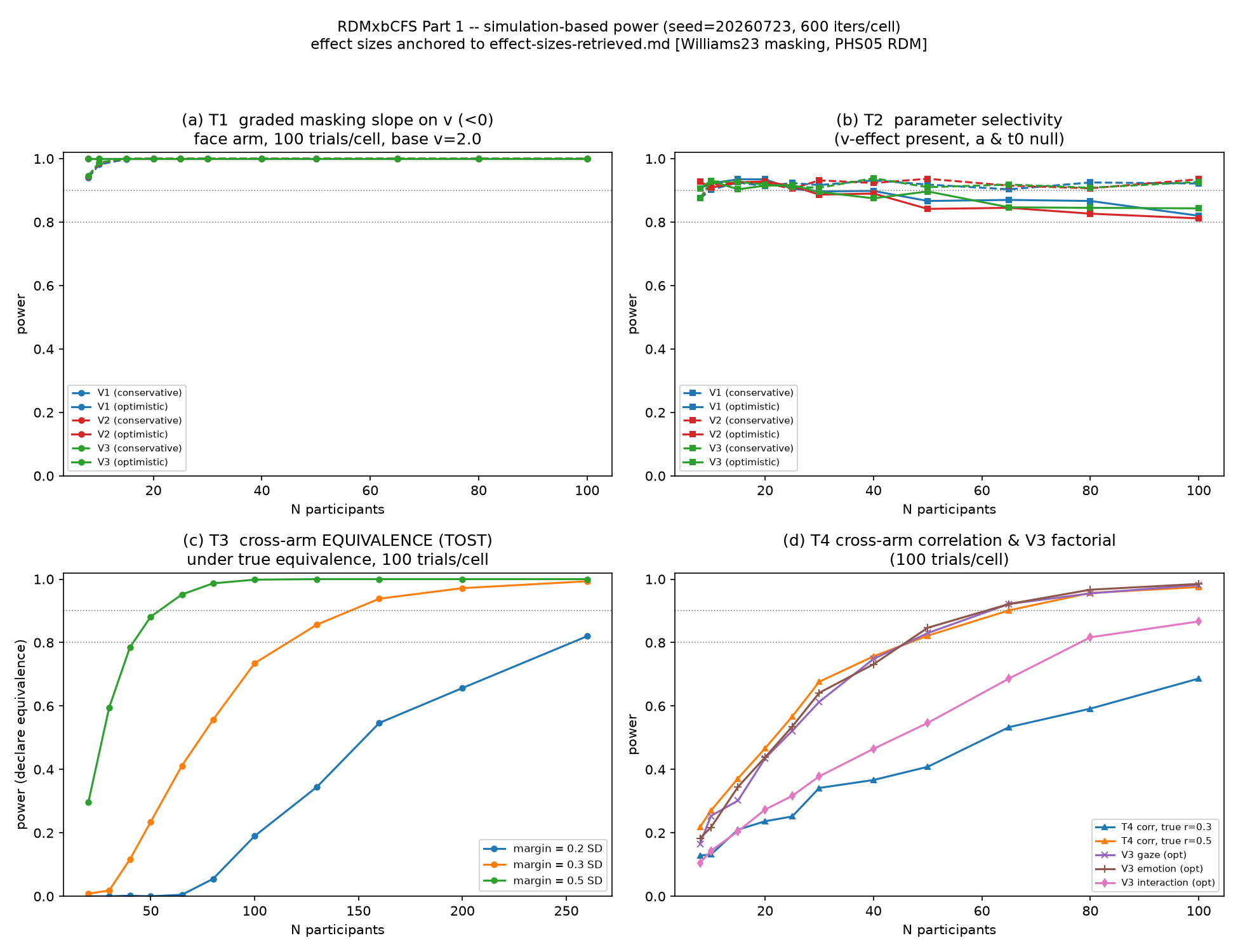
Binding constraint: N is driven by participants, not trials/cell (60→150 barely moves it).
The equivalence-margin trade-off
Sample-size recommendation + PI leaning
PI's instinct
Leans toward tiers ① (cheap validation) and ④ (full factorial) — the two ends of the ambition spectrum.
Grounded compromise path
- Flagship V2 at N≈50 (tier ②, best-anchored arm)
- V1 gaze pilot (~10) in parallel, to obtain the missing drift anchor
- Pre-register ③ equivalence at Δ=0.3 as an honestly under-powered secondary outcome
- Upgrade to ④ factorial, N≈130 in a committed follow-up
This is the decision the team makes in the room today — the tier choice determines what Part 1 can honestly claim.
Decisions on the table
Five explicit decisions. For each: the question, every option with its argument for and its cost, and the current leaning — marked as a leaning, not decided.
- D1Discrimination axis / design version — V1 gaze vs V2 emotion vs V3 factorial
- D2Obscuring mechanism — graded Mondrian mask vs noise degradation vs dichoptic b-CFS
- D3Power anchor — Williams 2023 vs Sawada 2022 vs both, bracketed
- D4Claim tier — validation vs +convergent vs strong equivalence vs factorial
- D5Equivalence margin (if tier ③) — Δ = 0.5 vs 0.3 vs 0.2
QWhich face-discrimination axis is the flagship — and why RaFD, not FACES or synthetic?
V1 — Gaze (L / R) 0/19
V2 — Emotion (angry / happy) anchored
V3 — Factorial (gaze × emotion)
Why RaFD, not FACES: RaFD ships 3 gaze directions; FACES is frontal-only, which would rule out V1 and V3 entirely. RaFD is justified on its own validation (Langner 2010); it is used by our anchor paper (Williams 2023, Study 1), so it is not novel to the corpus.
Why not synthetic: an in-house synthetic set is used only for pipeline/recovery tests — it lacks the ecological validity and norming a substantive face claim requires.
QHow do we grade the face's discriminability across the difficulty ladder?
Graded binocular Mondrian mask novel · 0/19
Contrast / phase-noise degradation
Dichoptic b-CFS out of scope
QWhich effect size anchors the masking→drift power analysis?
Williams 2023 only
Sawada 2022 only
Both, bracketed chosen
QHow strong a claim does Part 1 make — and at what participant cost?
① Validation N≈12–16
② +Convergent N≈50–65
③ Strong equivalence N≈50–260
④ Full factorial N≈80
QIf we pursue strong equivalence (T3 / TOST), how tight a margin do we defend?
Δ = 0.5 — lenient N≈50
Δ = 0.3 — moderate N≈130
Δ = 0.2 — strict N≈260
The margin is a PI judgment call: it fixes what "equivalent" means before any data are seen, and every 0.1 SD tighter roughly doubles the sample.
Simulated power — how each tier's N was set
The N's in D4/D5 are not rules of thumb: each is read off a Monte-Carlo simulation of this exact pipeline.
How to read the next five figures
- Each is the empirical sampling distribution of the actual test statistic, 3,200 iterations per arm, at the recommended N.
- The H0 curve = no effect; the H1 curve = the true (bracketed) effect.
- The 5% α critical value and the power region (target 80%) are shaded directly on the curves.
Which figure backs which decision
- Scenario 1 → tier ① (D4) · V2 / T1
- Scenario 2 → tier ② (D4) · V2 / T4
- Scenario 3 → tier ③ (D4) + D5 margin · T3 TOST
- Scenario 4 → tier ④ (D4) · V3 interaction
- Scenario 5 → V1 gaze pilot (D1) · extrapolated
Validation — N = 16 (V2, test T1)
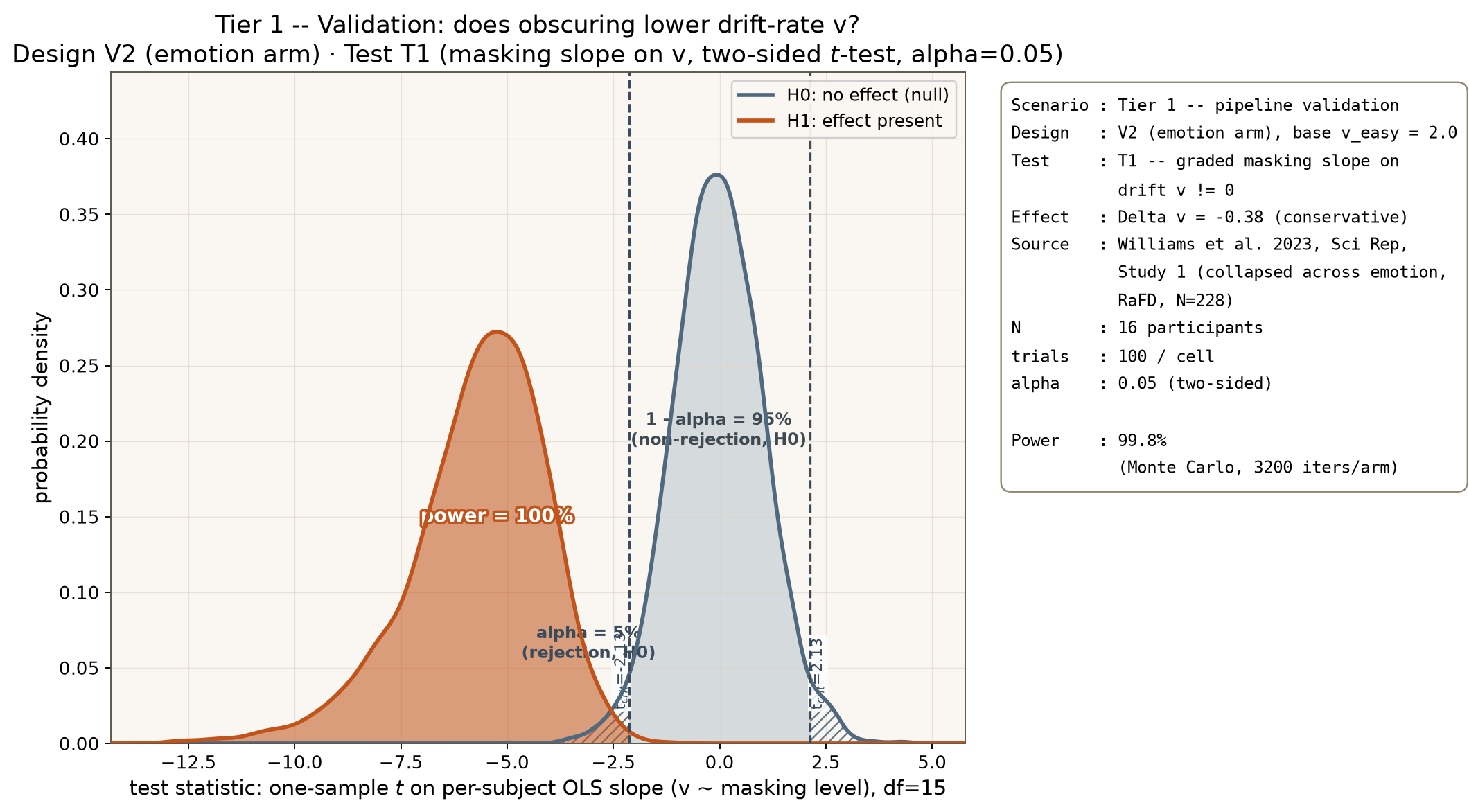
Because the masking effect is huge relative to N=16 sampling noise, the two distributions barely overlap — achieved power 99.8%. “Obscuring lowers drift” is essentially guaranteed to be detected.
The honest reading: N=16 is already more than this test needs. The real constraint on tier ① is practical (recruit a small cohort), not statistical.
Convergent validity — N = 50 (V2, test T4)
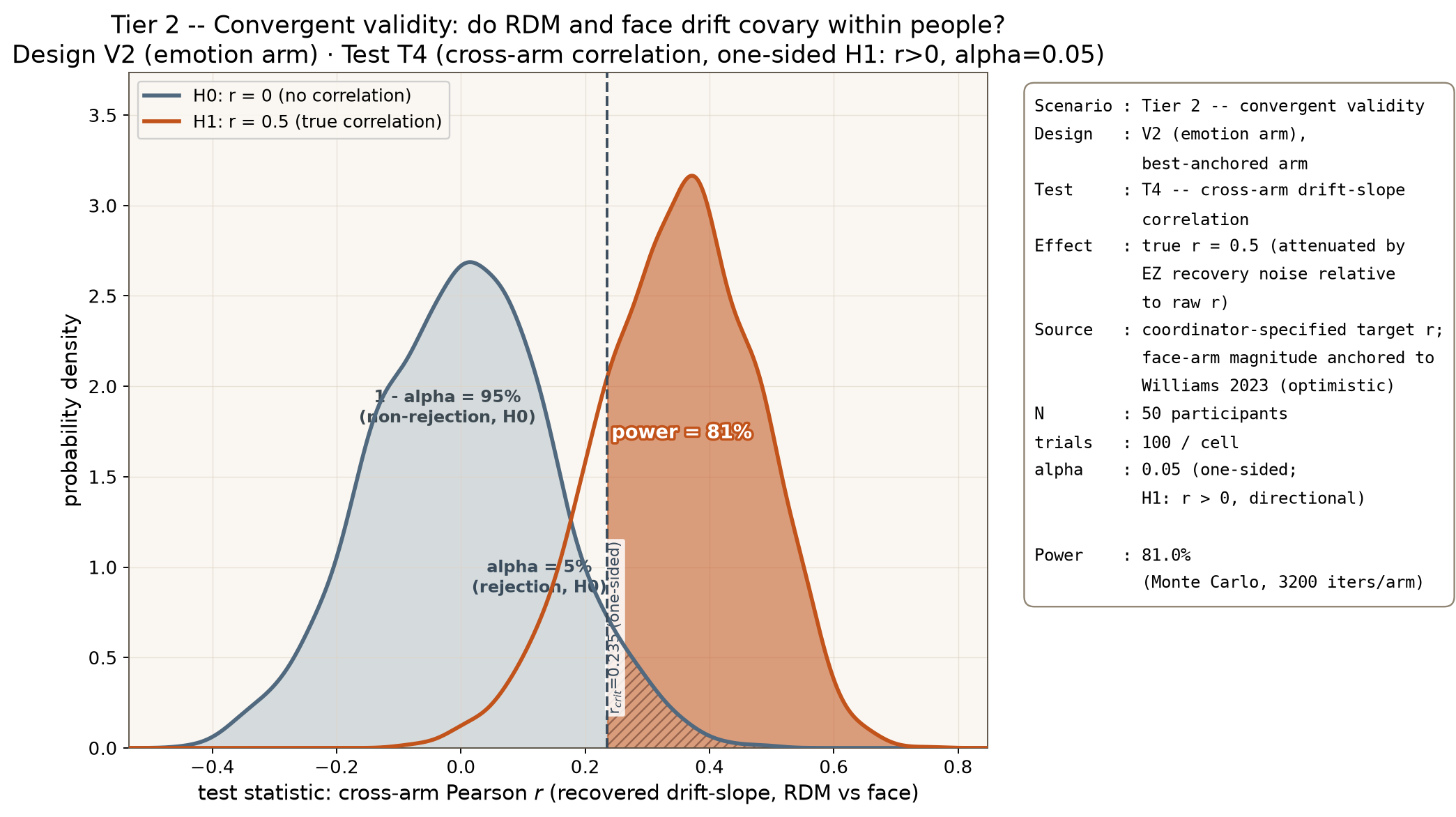
Recovered r is centered near 0.35–0.40 — attenuated well below the true 0.5 by EZ-recovery noise. That attenuation is exactly why N=50, not the textbook ~28, is required for 80% power.
Achieved power 81.0% — matches the report's headline N=50 recommendation for the recommended default tier.
Strong equivalence — N = 130, Δ = 0.3 (test T3, TOST)
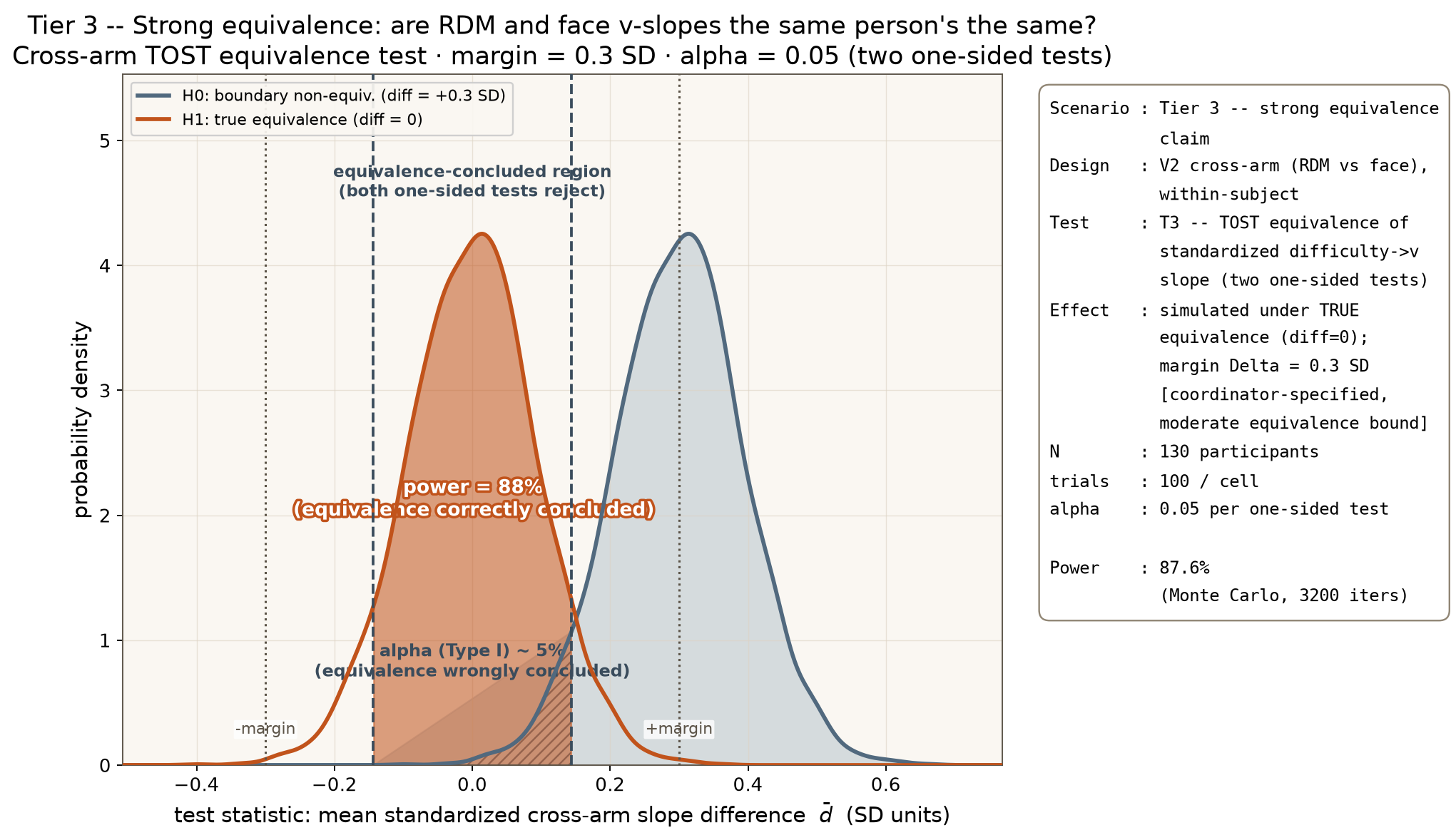
Mass of the true-equivalence curve inside the acceptance interval = power (87.6%); the boundary-null curve inside it = Type-I error (≈5%).
The single most expensive claim in the design. N=130 buys only the moderate Δ=0.3 margin (D5); a tighter, more defensible Δ=0.2 needs roughly double.
Full factorial — N = 80 (V3, gaze × emotion interaction)
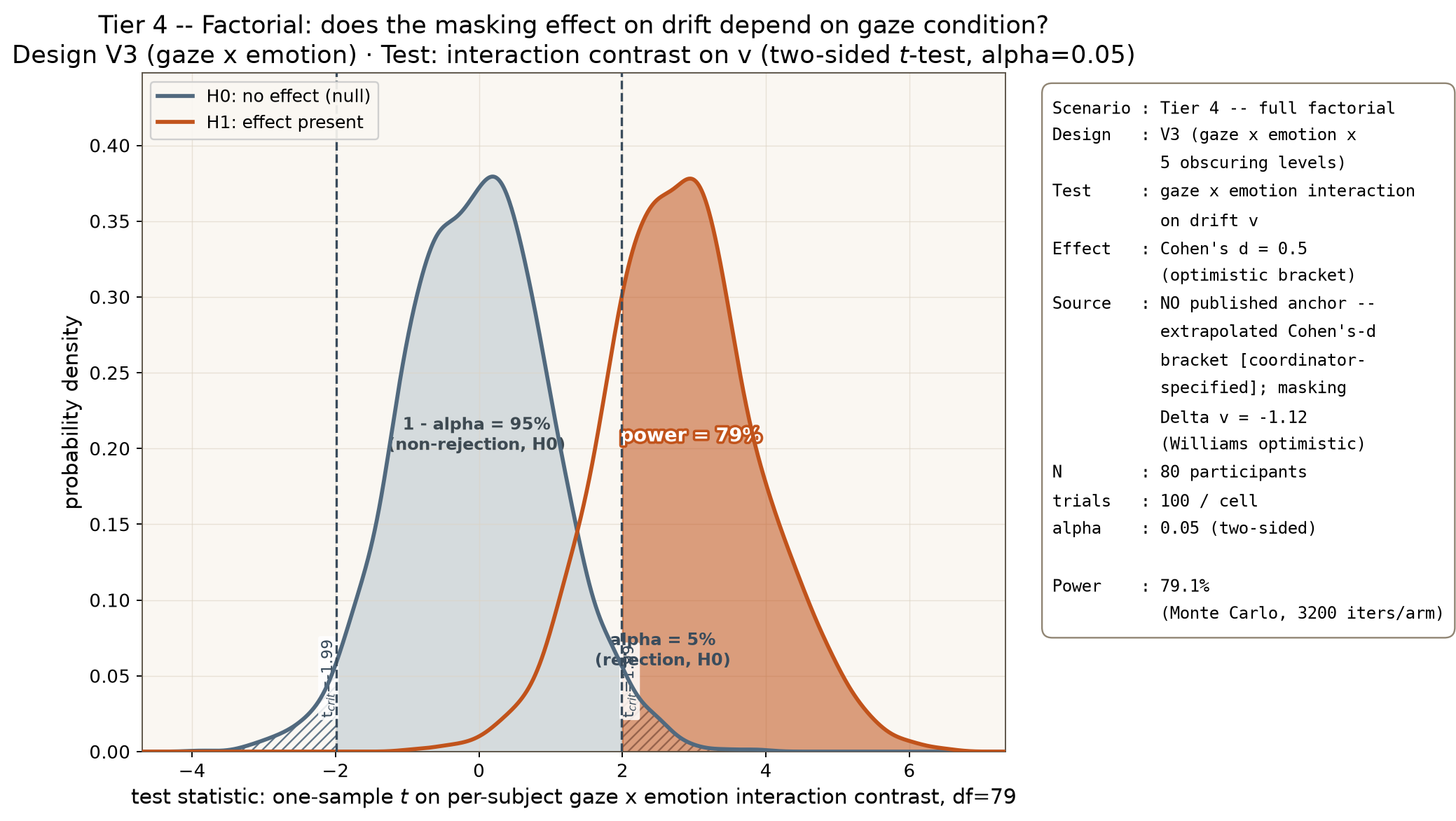
Achieved power 79.1% — right at the 80% line, but only under the optimistic effect. No published anchor exists for this interaction.
The design's most fragile confirmatory claim: under the conservative bracket it is not reached at all without N well beyond 80.
Gaze arm — N = 10 pilot (V1, EXTRAPOLATED)
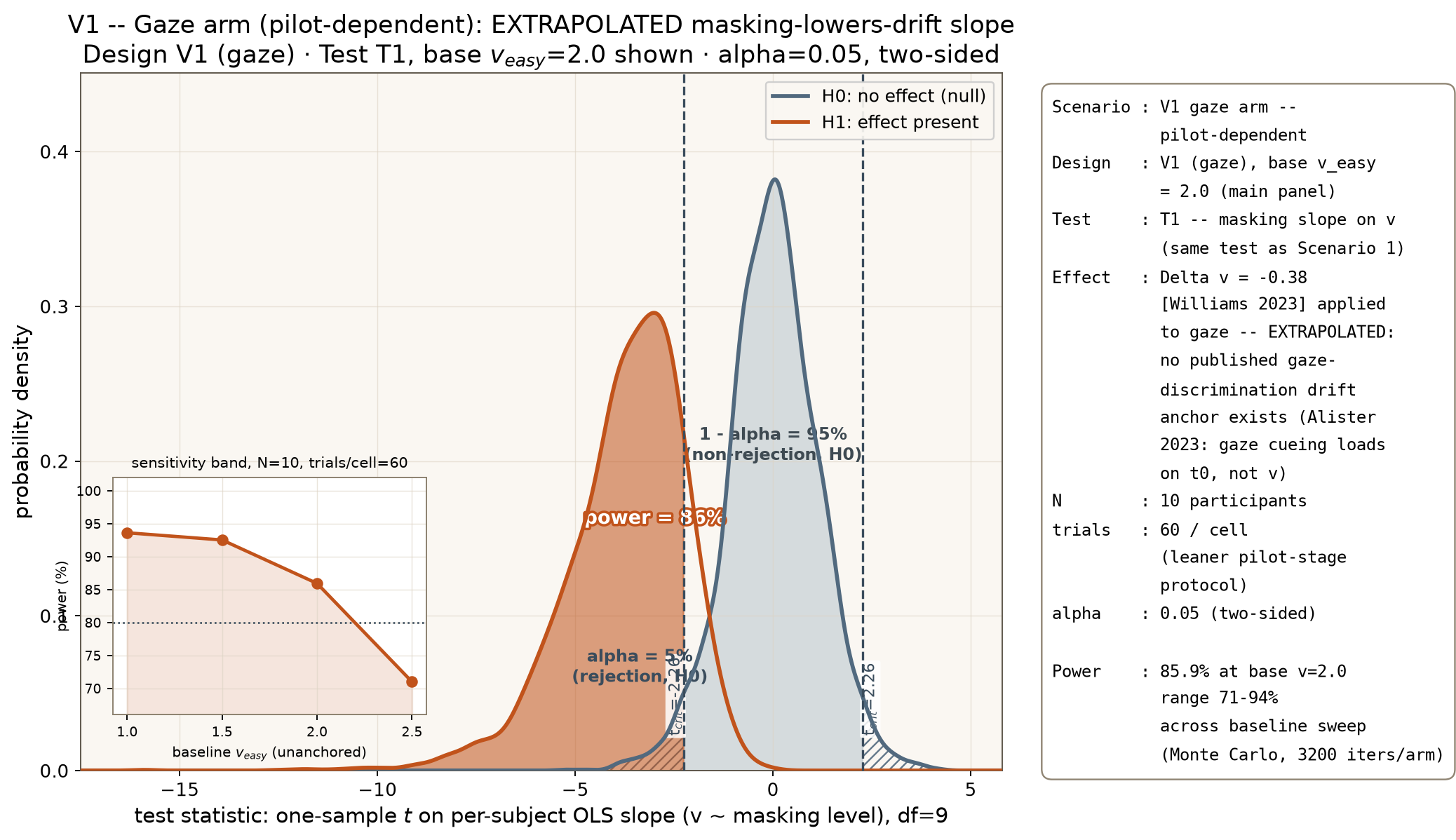
The Williams Δv=−0.38 slope is borrowed onto a gaze task with no published drift anchor (Alister: gaze cueing loads on t₀, not v). So the power claim is a range (71–94%), not a point.
The band straddles the 80% line — which is the argument for running the ~10-subject pilot (D1) before committing a full V1 sample.
Best-practice spine + roles & milestones
- Pre-registration (hypotheses, N, exclusions, margin)
- Adaptive per-subject calibration (QUEST/Ψ) — novel for face-DDM
- Graded difficulty in both arms, matched levels
- EZ (screen) + HDDM (confirm); report recovery
- Low-level confound controls; counterbalancing
- Distributional RT analysis — never mean-RT
- Open task, analysis, and data
Contract approved
today
RaFD subsets + masks built
+2 wk
Two-arm PsychoPy task running
+4 wk
V1+V2 pilot (~10)
+6 wk
Pre-registration
+8 wk
Main collection (N≈50)
+8–16 wk
DDM analysis + writeup
+16–20 wk
Research gaps — the decision to be made today
- No drift-rate estimate exists for gaze-direction discrimination — V1 answers this.
- Graded masking of faces + full DDM has never been run — T3 answers this.
- Within-person equivalence of a "high-level" and "low-level" decision is untested — a domain-general accumulation claim.
- Reliability/individual-differences of face-DDM parameters is essentially unstudied (T4) — a tool for clinical/developmental work.
- Sawada 2022 magnitude gap — a concrete literature-completion task.
The decision for the room: which claim tier (§6) and which design version (§3) do we commit to for Part 1?
Two audio deep-dives
Spoken walkthroughs — a general overview and a focused dive on the design decisions and DDM parameters.
General deep-dive
The whole design contract — two-arm structure, the three versions, the golden-standard literature comparison, the power analysis, and the open questions.
Design decisions & parameters
A focused dive on the design choices and the four DDM parameters (v, a, t₀, z) — why each option was taken and what it buys.
Annex
Supporting material — full tables, checklists, figures, and references
- A1Full 19-paper comparison table
- A1·Which design each paper uses — linked (bib + PDF)
- A2The 8-criterion checklist
- A3Per-test / per-version N tables
- A4Equivalence-margin table (T3, full)
- A5Parameter recovery — recovery_scatter.png
- A6Effect-size provenance table
- A7Full milestone timeline + roles
- A8RaFD dataset structure
- A9Glossary of DDM terms
- A10References — key anchors & corpus
Full 19-paper comparison table
Verdicts against the 8-criterion checklist. Every paper's reference + full text is linked in the companion design table on the next slide.
| Paper | DOI | Verdict | One-line reason |
|---|---|---|---|
| Sawada, Sato, Nakashima & Kumada 2022 | 10.1016/j.cognition.2022.105235 | PARTIAL | Face-in-crowd detection, not single-face 2AFC; no graded masking; best precedent for anger/happy→v direction. |
| Brennan & Baskin-Sommers 2020 | 10.1177/0956797620904157 | PARTIAL | Emotion-identification (likely >2 alternatives); no masking; individual-difference design. |
| Brennan & Baskin-Sommers 2021 | 10.1037/per0000473 | PARTIAL | 3-way blend/context grading, not occlusion; >2 response options. |
| White, Ratcliff, Vasey & McKoon 2010 | 10.1037/a0019474 | FAIL | Threat words, not faces — fails stimulus criterion outright. |
| Williams, Haque, Mai & Venkatraman 2023 | 10.1038/s41598-023-35381-4 | PARTIAL | Best masking precedent; but 6-way choice and binary (not graded) masking. Strongest structural match overall. |
| Hartmann et al. 2021 (preprint) | 10.31234/osf.io/a8yxf | PARTIAL (low conf.) | Duplicate of Williams 2023 design; no independent verifiable data. |
| Ozturk et al. 2024 | 10.1016/j.bpsgos.2023.07.005 | PARTIAL | Graded manipulation is cue uncertainty, not masking of the face itself. |
| Nagrodzki et al. 2025 | 10.1037/emo0001499 | FAIL | Face is a task-irrelevant incidental prime, not the judged stimulus. |
| Klein & Todd 2024 | 10.3758/s13423-024-02526-z | FAIL | 2AFC axis is weapon-vs-tool identification; face is priming context. |
| Nan et al. 2024 | 10.1016/j.psyneuen.2023.106948 | PARTIAL (strong) | Morph-continuum grading, not occlusion/masking; pharmacological RCT design. |
| Schreiber, Hall, Parr & Hallquist 2025 | 10.1017/S0033291725000595 | PARTIAL | Difficulty via congruent/conflicting emotion words, not masking. |
| Haller et al. 2024 | 10.1093/scan/nsae034 | PARTIAL (strong) | Morph-continuum labeling, closest emotion-axis analog; small N=44 (fMRI). |
| Schrader, Habel, Jo, Walter & Wagels 2023 | 10.1016/j.concog.2023.103493 | PARTIAL (strong) | Graded exposure duration — genuine masking-like manipulation; but 3-way choice. |
| Yang, Brunet-Gouet, Burca, Kalunga & Amorim 2020 | 10.3389/fnhum.2020.00340 | PARTIAL | Upright/inverted × photo/sketch degradation; binary factorial, not graded continuum. |
| Evans et al. 2025 | 10.1080/02699931.2025.2533382 | FAIL (axis) | Approach-vs-avoid choice, not emotion/gaze identification. |
| Maka, Chrustowicz & Okruszek 2023 | 10.1111/psyp.14406 | FAIL (axis) | Dot-probe task — response is about probe location, not the face. |
| Tipples 2023 | 10.1037/emo0001098 | PARTIAL | Methods-critique paper, not a new effect-size report; no masking. |
| Alister, McKay, Sewell & Evans 2023 | 10.1177/17470218231181238 | PARTIAL | Best-powered gaze precedent (N=171, 139,001 trials); but cueing task, not direct gaze judgment. |
| Palmer, Caruana & Clifford 2018 | 10.1098/rsos.180885 | PARTIAL | Closest gaze-axis task structure; but no DDM fit at all — threshold-only. |
Which design does each paper use — linked
Stimulus set · axis · degradation · DDM software · titration · N. Each row links to its bibliography entry (bib) and full text (pdf local, or doi where no PDF is held).
| Paper | Stimulus set | Axis | Degradation | DDM software | Titration | N |
|---|---|---|---|---|---|---|
| Sawada et al. 2022bibdoi | not stated (face-in-crowd) | Emotion (angry/happy vs anti-expr.) | anti-expression control (not graded mask) | custom (Ratcliff-style) | none | n/r |
| Brennan & Baskin-Sommers 2020bibdoi | not stated | Emotion (anger) | none (individual-difference) | not stated (DDM) | none | 90 |
| Brennan & Baskin-Sommers 2021bibdoi | not stated | Emotion (anger/happy/fear blends) | blend + threat context (not mask) | not stated | fixed blend levels | 92 |
| White, Ratcliff, Vasey & McKoon 2010bibpdf | threat words (not faces) | lexical decision | none | Ratcliff full-DDM | none | n/r |
| Williams, Haque, Mai & Venkatraman 2023bibpdf | RaFD (S1) / RADIATE (S2) | Emotion (6-way, incl. anger) | mask occlusion (binary) | DDM (not named) | none (binary) | 228 / 264 |
| Hartmann et al. 2021 (preprint)bibpdf | as Williams | Emotion (6-way) | mask occlusion (binary) | not stated | none | as Williams |
| Ozturk et al. 2024bibdoi | not stated | Threat vs neutral | pre-stimulus cue uncertainty (not face mask) | HDDM + SDT | none | 55 |
| Nagrodzki et al. 2025bibdoi | not stated | Angry/neutral (task-irrelevant) | none (incidental prime) | DDM | none | 134 |
| Klein & Todd 2024bibpdf | Black/White faces (prime) | weapon ID (face incidental) | expression salience factor | diffusion decision model | none | 546 |
| Nan et al. 2024bibpdf | not stated | Emotion (anger/fear morphs) | morph continuum (not occlusion) | DDM + SDT | fixed morph levels | 120 |
| Schreiber, Hall, Parr & Hallquist 2025bibpdf | not stated | Emotion decoding | emotion-word conflict (not mask) | HDDM | none | 86 |
| Haller et al. 2024bibdoi | not stated | Emotion (happy-angry morph) | morph continuum | DDM (sens./bias) | fixed continuum steps | 44 |
| Schrader, Habel, Jo, Walter & Wagels 2023bibdoi | not stated | Emotion (sad/neutral/happy, 3-way) | graded exposure duration (8.3/16.7/25 ms) | HDDM | 3 fixed durations | 40 |
| Yang et al. 2020bibpdf | photo / sketch versions | Emotion recognition | inversion + sketch (not occlusion) | DDM + ERP | none (binary factorial) | n/r |
| Evans et al. 2025bibdoi | happiness/anger morphs | approach/avoid (face incidental) | morph continuum | DDM | fixed morph levels | n/r |
| Maka, Chrustowicz & Okruszek 2023bibdoi | not stated | dot-probe (face incidental) | none | DDM + N2pc | none | 52 |
| Tipples 2023bibpdf | not stated | Emotion (angry vs happy, 2AFC) | none (methods critique) | recommends DDM / ex-Gaussian | none | n/r |
| Alister, McKay, Sewell & Evans 2023bibdoi | real face photos (gaze-cueing) | Gaze (cue; response = target) | none (congruent/incongruent) | diffusion / LBA, hierarchical Bayes | none | 171 |
| Palmer, Caruana & Clifford 2018bibdoi | own gaze photos (not RaFD) | Gaze (left/right, direct 2AFC) | head × eye angle (graded angle, not occlusion) | none (threshold-only) | per-participant threshold | 22 SZ / 27 HC |
“not stated” = the value is absent from the KB card and needs primary-source retrieval; “n/r” = no numeric N reported. Values quoted verbatim from data/analysis/ddm-face-comparison.md §3.
The 8-criterion checklist
| # | Criterion | Operational test |
|---|---|---|
| C1 | Forced binary choice (2AFC) | Exactly two response options — not go/no-go, not >2-way categorization, not a rating scale. |
| C2 | Face stimuli | Discriminated stimulus is a face image — not words, dot arrays, or objects. |
| C3 | Axis = gaze OR emotion of the face itself | Judgment is about the face's own gaze/emotion — not a downstream cued target or orthogonal task. |
| C4 | Graded difficulty via masking/obscuring | Discriminability parametrically manipulated by occlusion/noise/masking — not fixed-intensity prototypes only. |
| C5 | Full DDM fit reported | Drift rate v recovered via a diffusion/sequential-sampling model — not threshold-only or SDT d′ alone. |
| C6 | Within-participant repeated measures | Same subjects run across multiple difficulty/condition levels. |
| C7 | RaFD or comparably validated stimulus set | RaFD, KDEF, NimStim, or FACES with reported norms — not unvalidated in-house photos. |
| C8 | Adequate trial counts for per-cell recovery | N and trials/condition sufficient in principle for stable v estimation (≥100/cell EZ, ≥20–40/cell HDDM). |
All eight required for a strict PASS; satisfying task-family intent but failing structural items = PARTIAL; failing the core task family = FAIL.
Per-test / per-version minimum-N tables
T1 / T2 — validation core
| Test | V1 | V2 | V3 |
|---|---|---|---|
| T1 (masking lowers v) | ≤8 | ≤8 | ≤8 |
| T2 (drift-specific) | 8–10 | 8–10 | 8–10 |
T4 — convergent validity
| True r | min N 80% | min N 90% |
|---|---|---|
| r = 0.5 | 50 | 65 |
| r = 0.3 | >100 | >100 |
V3 factorial — main effects & interaction (optimistic bracket)
| Contrast | min N 80% | min N 90% |
|---|---|---|
| Gaze main effect | 50 | 65 |
| Emotion main effect | 50 | 65 |
| Gaze × emotion interaction | 80 | >80 |
Conservative bracket: V3 main effects/interaction not reached within the simulated grid — factorial version viable only under optimistic effects or N ≥ ~80.
T3 equivalence — full margin table
| Target power | Margin Δ (SD) | Min N |
|---|---|---|
| 80% | 0.2 (strict) | 260 |
| 80% | 0.3 (moderate) | 130 |
| 80% | 0.5 (lenient) | 50 |
| 90% | 0.2 (strict) | >260 (not reached) |
| 90% | 0.3 (moderate) | 160 |
| 90% | 0.5 (lenient) | 65 |
This is the binding constraint and the PI's decision. Trials/cell (60/100/150) barely move these N's — the cost is entirely in participants. Williams' masking is binary; our graded severity is an interpolated assumption, to be re-estimated from pilot data.
Parameter recovery — recovery_scatter.png
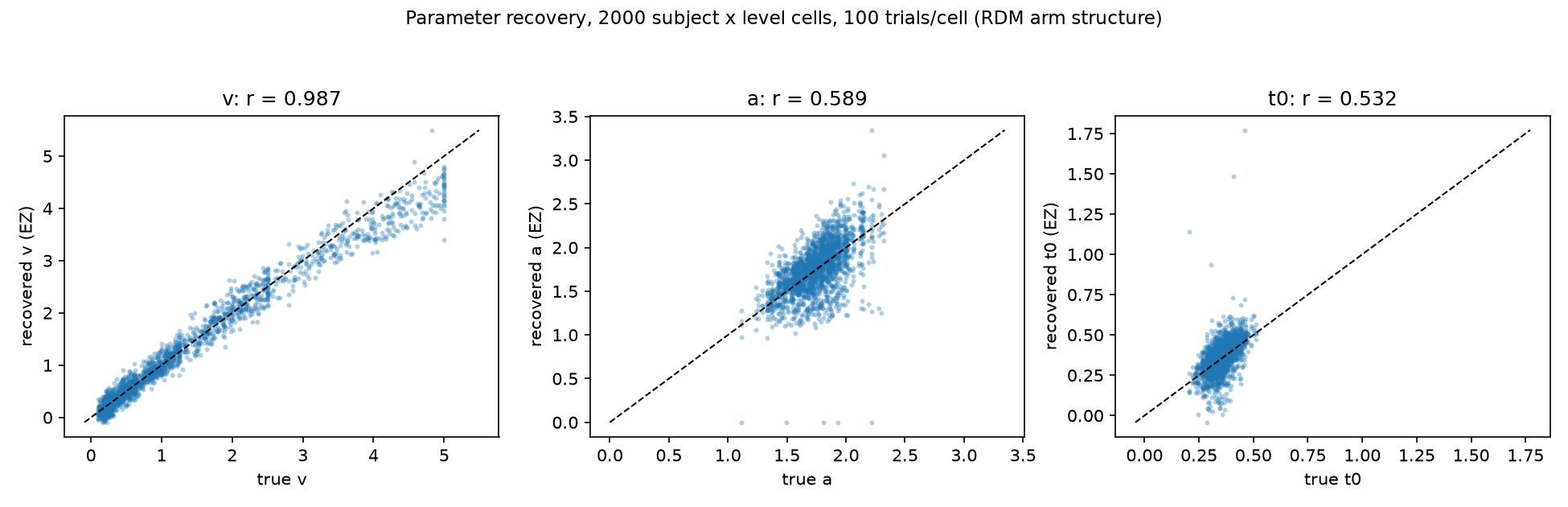
- rv
- 0.9873 — excellent
- ra
- 0.5894 — weak
- rt₀
- 0.5317 — weak
- RT-variance inflation
- ≈ 3.95×
- Drift rescaling
- SCALE_K = 0.32552 (PHS05 k=21.0 → top-coherence v=3.5)
n=2000 synthetic subjects, seed 20260723. Drift is recovered cleanly; boundary and non-decision time are not — motivates HDDM confirmatory fitting for the selectivity claim.
Effect-size provenance table
| Source | Design | Value | Status |
|---|---|---|---|
| Williams et al. 2023, Study 1 | RaFD, N=228, DDM (software not named), 648 trials/pp | masking→v: b=−0.38 [−0.41,−0.34] | Retrieved (PMC full text) |
| Williams et al. 2023, Study 2 | RADIATE, N=264, DDM (software not named), 324 trials/pp | masking→v: b=−0.65 [−0.71,−0.59]; happiness/sadness up to b=−1.12 | Retrieved (PMC full text) |
| Williams et al. 2023 (boundary a) | same | a ≈ 1.67–1.80 across mask/emotion conditions | Retrieved; no t₀/z reported anywhere |
| Sawada et al. 2022 | face-in-crowd detection | direction only: v↑, t₀↓, a↑ for normal vs. anti-expression | GAP — paywalled, no OA/preprint found |
| Palmer, Huk & Shadlen 2005 (PHS05) | 6 observers, coherence 3.2–51.2% | µ′=k·x; mean k=20±3 (Exp.1), k=21±1/22±1 (Exp.3); A′≈0.6–0.86; tR≈300–420ms; threshold ratio≈3.0–3.8 | Retrieved (author PDF, PyMuPDF extraction) |
| Alister, McKay, Sewell & Evans 2023 | 3 gaze-cueing datasets, N=171, 139,001 trials | v has lowest model-inclusion probability (3–13%) of the 3 DDM parameters; no numeric v/z shift reported | GAP — v/z magnitudes not numerically reported |
| Palmer, Caruana, Clifford & Seymour 2018 | gaze 2AFC, N=22 SZ / 27 HC | cone-model half-difference: SZ 9.94° (sd 9.58°); HC 10.68° (sd 6.81°) | Retrieved; no DDM fit exists in this paper |
Full milestone timeline + roles
| # | Milestone | Owner | Target |
|---|---|---|---|
| M0 | This contract approved | all | today |
| M1 | RaFD subsets + graded Mondrian masks built | techs | +2 wk |
| M2 | PsychoPy two-arm task (RDM + face) running | techs + analysts | +4 wk |
| M3 | V1 gaze + V2 emotion pilot (~10) → real drift anchors, mask-level slopes | all | +6 wk |
| M4 | Pre-registration (final N, margin, exclusions) from pilot variance | PI + analysts | +8 wk |
| M5 | Main data collection (flagship V2, N≈50) | techs | +8–16 wk |
| M6 | DDM analysis, equivalence, writeup | analysts + PI | +16–20 wk |
Roles
- PI
- theory, design sign-off, pre-registration, equivalence-margin decision, writeup lead
- Lab techs
- RaFD subsetting, graded Mondrian mask generation, PsychoPy task build, apparatus, data collection
- Analysts
- EZ+HDDM pipeline, parameter-recovery checks, QUEST/Ψ code, power re-estimation, TOST, figures
Deliverables
- This contract
- Interactive KB webpage (
report/) - This illustrated deck — main acts + annex (
presentation/) - Golden-standard comparison
- Grounded power analysis
RaFD dataset structure
Radboud Faces Database (Langner et al. 2010)
67 IDs × 8 expressions × 5 camera angles × 3 gaze = 8040 images
- Models
- 67 (adults + children)
- Expressions (8)
- anger, disgust, fear, happiness, sadness, surprise, contempt, neutral
- Camera angles (5)
- full range; frontal angle used for this study
- Gaze directions (3)
- left / frontal / right
- Access
- free for academic use; on disk locally
- Used for
- V1 (gaze L/R), V2 (angry/happy), V3 (2×2 factorial)
Glossary of DDM terms
| Term | Meaning |
|---|---|
| 2AFC | Two-alternative forced choice — exactly two response options per trial |
| v (drift rate) | Average rate of evidence accumulation; the signal-quality parameter |
| a (boundary separation) | Distance between the two decision thresholds; speed–accuracy tradeoff |
| t₀ / Ter (non-decision time) | Encoding + motor time outside the accumulation process |
| z (starting point / bias) | Where accumulation begins relative to the two boundaries |
| µ′ = k·x | Proportional-rate diffusion model: drift scales linearly with stimulus strength x, sensitivity k |
| EZ-diffusion | Fast, closed-form per-subject DDM estimator (Wagenmakers 2007) |
| HDDM | Hierarchical Bayesian DDM fitting package (Wiecki, Sofer & Frank 2013) |
| TOST | Two one-sided tests — the standard statistical procedure for testing equivalence |
| QUEST / Ψ | Adaptive psychophysical staircase procedures for per-subject difficulty calibration |
| Parameter recovery | Simulation check: can the fitting procedure recover known true parameter values? |
References — key anchors & corpus
Key anchors
- Palmer, Huk & Shadlen 2005 — J. Vision, DOI 10.1167/5.5.1
- Williams et al. 2023 — Sci. Reports, DOI 10.1038/s41598-023-35381-4
- Ratcliff & McKoon 2008 — DDM foundations
- Wiecki, Sofer & Frank 2013 — HDDM
- Wagenmakers et al. 2007 — EZ-diffusion
- Langner et al. 2010 — RaFD validation, DOI 10.1080/02699930903485076
- Tsuchiya & Koch 2005 — Mondrian CFS dynamics
- Stein, Hebart & Sterzer 2011 — b-CFS background
- Tipples 2023 — Emotion, DOI 10.1037/emo0001098
Full bibliography: data/biblio/references.yaml (140 entries).
Corpus & provenance sources
- 19-paper golden-standard comparison:
data/analysis/ddm-face-comparison.md - Retrieved effect sizes:
data/analysis/effect-sizes-retrieved.md - Power analysis:
data/power/power_report.md,power_analysis.py - Contract source:
design/2026-07-23-rdmxbcfs-part1-design.md - Alister, McKay, Sewell & Evans 2023 — QJEP, DOI 10.1177/17470218231181238
- Palmer, Caruana, Clifford & Seymour 2018 — R Soc Open Sci, DOI 10.1098/rsos.180885
- Sawada, Sato, Nakashima & Kumada 2022 — Cognition, DOI 10.1016/j.cognition.2022.105235