The Design
Two binocular 2AFC arms, within participant — the structure, the three candidate versions, the stimuli, the novel obscuring mechanism, the best-practice spine, and the working agreement (roles & milestones).
2 · Experimental structure — two arms, within participant
Each participant completes two arms of a forced binary choice task. Presentation is binocular (both eyes, no dichoptic rivalry) — despite “CFS” in the project name, Part 1 is deliberately the pre-CFS validation baseline: the flashing Mondrians are a graded masking/degradation of a binocularly-viewed face, not interocular suppression. Both arms yield choice + RT on every trial → DDM.
| Arm A — RDM | Arm B — Faces (RaFD) | |
|---|---|---|
| Binary choice | left vs. right motion | gaze L/R, or angry/happy — see §3 |
| Difficulty ladder | ~5 motion-coherence levels {3.2, 6.4, 12.8, 25.6, 51.2}% | ~5 graded binocular flashing-Mondrian mask levels |
| DDM prediction | drift v ↑ with coherence (μ′ = k·x, k ~ N(21,6)) | drift v ↓ with obscuring (Δv ≈ −0.38 … −1.12) |
| Anchor | Palmer, Huk & Shadlen 2005PDF | Williams et al. 2023PDF (RaFD, DDM) |
| Dependent measures | choice + RT → v, a, t₀, z (both arms) | |
v, a, t₀, z on every trial.The scientific tests
- T1 — graded within-subject drop in
vacross obscuring (does obscuring lower drift?). - T2 — parameter selectivity (is the effect drift-specific —
vmoves,a/t₀don’t?). - T3 — cross-arm equivalence (TOST) — is the coherence→
vslope quantitatively equivalent to the obscuring→vslope in the same person? This is the claim that certifies the pipeline as a reusable tool. - T4 — individual-differences convergent validity — do motion-drift and face-drift covary across people?
b-CFS framing: why Part 1 is deliberately not yet CFS
A spoken explainer on why the project name says “bCFS” but Part 1 uses plain binocular graded masking, not interocular suppression — and what breaking-CFS (b-CFS) would add in a later part.
assets/flagship-design.svg.3 · The three design versions
Stimulus set for all versions: RaFD (Radboud Faces Database) — on disk, 8,040 images, 67 IDs × 8 emotions × 5 camera angles × 3 gaze directions (left / frontal / right). Frontal camera angle used throughout.
Left vs. right gaze direction
Literature anchor: none — no published gaze-discrimination drift estimate exists. Elegant structural parallel to RDM motion-direction.
Highest novelty; pilot-dependent.
Angry vs. happy
Literature anchor: Williams 2023PDF (masking→v on RaFD) — the closest published anchor the field offers, though its occlusion geometry differs from our graded noise mask (see Power caveats).
Best-anchored available; recommended flagship.
Gaze × emotion (2×2)
Literature anchor: partial (emotion anchored, gaze not).
Richest, most publishable single study; largest N. PI leans here.
Example stimuli — the manipulated dimensions
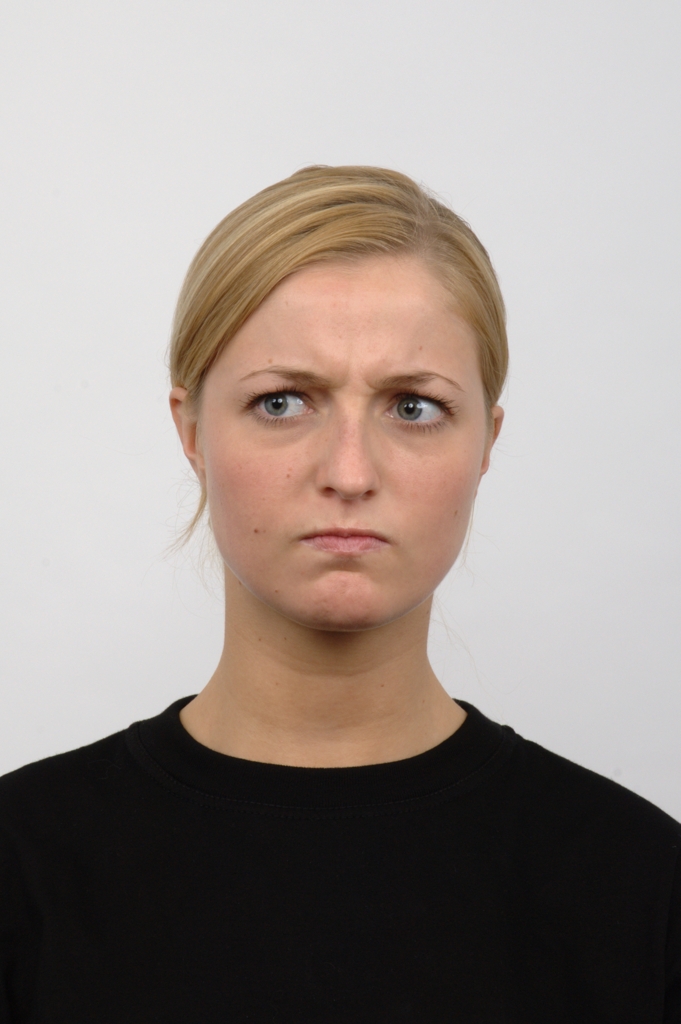



Radboud Faces Database (RaFD), Langner et al. 2010PDF — academic use, kept local. Frontal camera (Rafd090). These are the real manipulated dimensions the task discriminates.




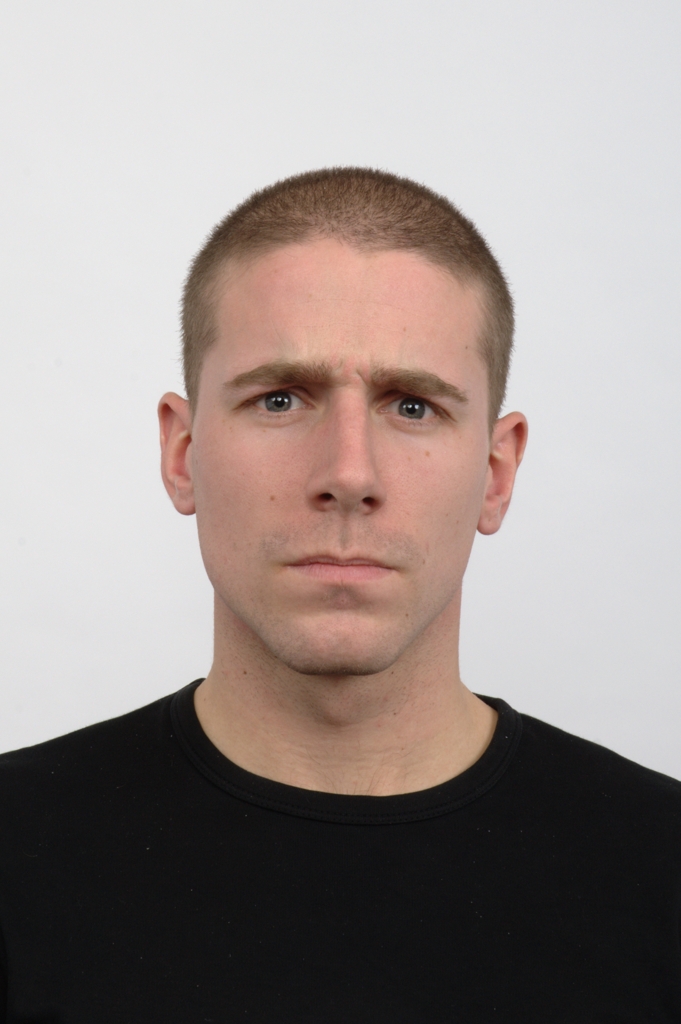

A separate in-house synthetic face set (assets/faces/ex_*.png) exists only as an illustrative pipeline-test set — the study stimuli are RaFD.
4 · Stimuli, apparatus, task — and where each choice comes from
- RaFD faces — used by our anchor paper (Williams 2023, Study 1), so it is not novel to the corpus; using it is justified on RaFD’s own validation (Langner et al. 2010PDF) and norming and its 3 gaze directions (needed for V1/V3), not on face-DDM precedent. Low-level confounds (luminance, contrast, spatial frequency) controlled per Purcell 1996, Becker 2011, Calvo 2016.
- Graded binocular Mondrian masking 0/19 precedent — only 1 distinct precedent masks at all (Williams 2023; Hartmann 2021 is its preprint — not an independent second study, so the corpus is effectively ≤18 distinct studies), and it is binary. A continuously graded mask is novel — justified from the RDM/CFS graded-noise tradition (Newsome & Paré 1988 for per-subject coherence/noise-dot calibration; Tsuchiya & Koch 2005 for 10 Hz Mondrian dynamics), not from a face-DDM precedent. Mask levels titrate discriminability, mirroring coherence in Arm A.
- Adaptive per-subject calibration — QUEST/Ψ 0/19 precedent — not one corpus paper uses adaptive staircase calibration of face-task difficulty. Imported wholesale from psychophysics (Watson & Pelli 1983PDF; Kontsevich & Tyler 1999) to equate difficulty across participants and across the two arms. A genuine methodological contribution for face-DDM.
- RDM task: built on the PI’s own open PsychoPy RDK (
abcsds/RDM, 2024). Coherence levels per Palmer, Huk & Shadlen 2005PDF (PHS05). - Gaze angle calibration (V1): seed left/right separation from Palmer, Caruana, Clifford & Seymour 2018 (cone half-difference ≈ 10°); confirm in pilot.
- Trials: target ≥100 correct trials/cell for the EZ baseline; ~20–40/cell adequate under HDDM shrinkage (Lerche, Voss & Nagler 2017PDF; Wiecki 2013PDF). Williams ran ~18/emotion×mask cell (sparse) — our design exceeds this.
The RaFD face stimulus set
A spoken walkthrough of the Radboud Faces Database — its validation, the frontal/gaze/emotion subsetting this design needs, and why using it is justified on its own norming merits — RaFD is used by our anchor paper (Williams 2023), so it is not novel to the corpus (see Comparison §3.5(a)).
The obscuring mechanism — a novel contribution
The single largest methodological gap the golden-standard comparison surfaces (see Comparison) is that no paper in the 19-paper corpus grades face-masking severity continuously — occlusion/masking has only 1 distinct precedent (Williams 2023; Hartmann 2021 is its preprint, not an independent study), and it is binary (masked vs. unmasked). A continuously graded occlusion/masking manipulation (percentage of face area obscured, or a stepped noise-mask series) has zero precedent in the reviewed literature. This design's graded binocular flashing-Mondrian mask — mirroring the coherence ladder in the RDM arm — must be justified from the RDM/b-CFS graded-noise literature (with Newsome & Paré 1988 cited specifically for per-subject coherence/noise-dot calibration) rather than from a face-specific precedent, since none exists.
RDM & DDM best practices behind this design
A spoken walkthrough of the RDM/psychophysics tradition this design borrows from: coherence-based graded difficulty, adaptive per-subject calibration, and the EZ+HDDM estimator pairing.
5 · Analysis pipeline (open-source)
- Per-subject baseline: EZ-diffusion (Wagenmakers 2007PDF) — fast, closed-form 0/19 precedent; chosen from best-practices, not corpus.
- Confirmatory: HDDM (Wiecki, Sofer & Frank 2013PDF) —
hierarchical Bayesian; the plurality choice among corpus papers that name a method (4/6). Required
because EZ recovers
a/t₀poorly (see Power §1 caveat). - Parameter recovery validated by simulation before fitting real data
(
r_v=0.99;r_a, r_t₀≈0.55–0.59under EZ — motivates HDDM for the selectivity claim). - Equivalence: TOST on standardized difficulty→
vslopes across arms, pre-specified margin (see Power §3.3). - Everything pre-registered; task code, analysis, and (permitted) data open.
z, drifts at rate v across the gap a between two boundaries after a non-decision time t₀, producing a choice and a response time.7 · Best-practice spine (golden standards)
- Pre-registration of hypotheses, N, exclusion rules, and the equivalence margin (before data).
- Adaptive per-subject calibration (QUEST/Ψ) to equate difficulty across arms — novel for face-DDM.
- Graded difficulty in both arms (coherence ↔ mask), matched in number of levels.
- EZ (screen) + HDDM (confirm); report parameter recovery.
- Low-level confound controls on RaFD stimuli; counterbalancing of arm order, response mapping.
- Distributional RT analysis — never mean-RT (Tipples 2023PDF: conclusions flip with outlier/model choice).
- Open task, analysis, and data; local-first tooling.
8 · Roles, milestones, deliverables
Roles
Theory, design sign-off, pre-registration, equivalence-margin decision, writeup lead.
RaFD subsetting (frontal; gaze L/R; angry/happy); graded Mondrian mask generation; PsychoPy task
build (extend abcsds/RDM); apparatus & binocular presentation; data collection.
EZ + HDDM pipeline; parameter-recovery checks; QUEST/Ψ calibration code; power re-estimation from pilot variance; TOST equivalence; figures.
Milestones (relative to 2026-07-23)
| # | Milestone | Owner | Target |
|---|---|---|---|
| M0 | This contract approved | all | today |
| M1 | RaFD subsets + graded Mondrian masks built | techs | +2 wk |
| M2 | PsychoPy two-arm task (RDM + face) running | techs + analysts | +4 wk |
| M3 | V1 gaze + V2 emotion pilot (~10) → real drift anchors, mask-level slopes | all | +6 wk |
| M4 | Pre-registration (final N, margin, exclusions) from pilot variance | PI + analysts | +8 wk |
| M5 | Main data collection (flagship V2, N≈50) | techs | +8–16 wk |
| M6 | DDM analysis, equivalence, writeup | analysts + PI | +16–20 wk |
Deliverables of this KB effort: the contract; this interactive KB website; the illustrated slide deck (main acts + annex); the golden-standard comparison; the grounded power analysis.